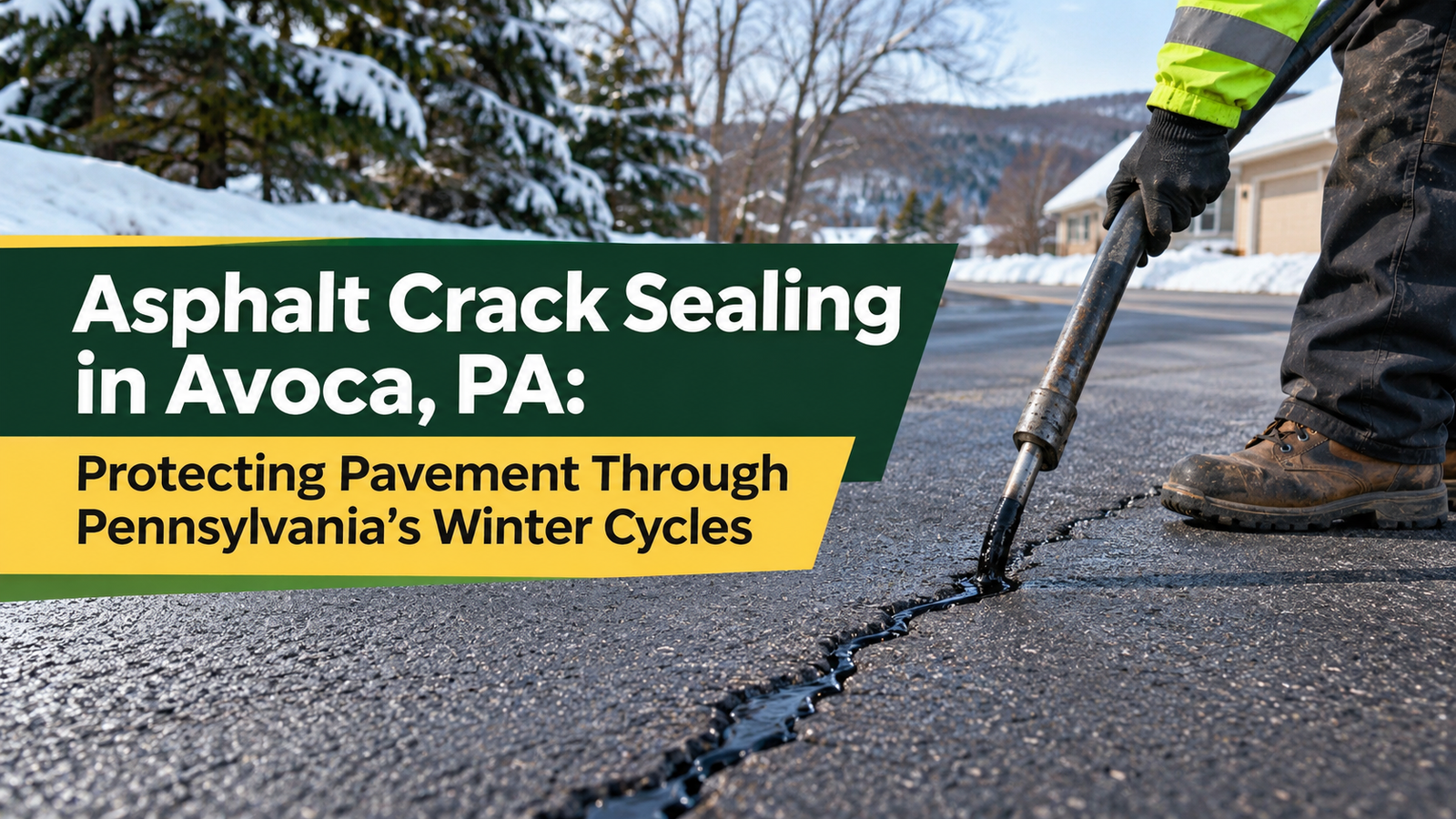
Crack sealing is one of the most important and most underutilized asphalt maintenance activities for property owners in northeastern Pennsylvania. Avoca and the surrounding Luzerne County communities sit in a climate zone where freeze-thaw cycling is not just a seasonal inconvenience but the primary mechanism by which asphalt crack sealing Avoca pavement deteriorates. Water enters pavement through cracks, freezes, expands, and progressively destroys the pavement structure from within. Crack sealing interrupts this process by closing the pathways through which water enters. Done consistently and at the right stage of pavement life, crack sealing extends pavement service life substantially and defers the far more expensive work of overlay or replacement.
How Cracks Form in Pennsylvania Asphalt
Asphalt is a flexible pavement material it is designed to flex slightly under load and to accommodate small movements without cracking. But asphalt is not infinitely flexible, and several mechanisms cause it to crack over time. Thermal cracking is one of the most common mechanisms in Pennsylvania: as temperatures drop in fall and winter, the asphalt binder contracts. If the binder has aged and stiffened through years of UV oxidation, it loses the flexibility to accommodate this thermal contraction and cracks transversely across the pavement in spaced intervals roughly correlated to the pavement’s thickness and the temperature drop.
Fatigue cracking also called alligator cracking when it covers an area in the interconnected block pattern results from repeated loading that exceeds the pavement’s structural capacity, usually because the base has weakened from water infiltration or inadequate original design. Reflective cracking occurs when an existing crack or joint in the base telegraphs through a new overlay layer, creating a crack in the new surface directly above the base discontinuity. Edge cracking develops at the pavement edge where there is no lateral support from a curb or berm, and the unsupported edge cracks longitudinally under load.
Each of these crack types has different implications for repair approach. Thermal and edge cracks in a structurally sound pavement are ideal candidates for crack sealing: the base is intact and sealing the crack closes the water infiltration pathway that would lead to base weakening and further deterioration. Alligator cracking indicates base failure that crack sealing alone cannot address the failed base section must be removed and rebuilt. Reflective cracking in an overlay is best addressed with routing and sealing or with crack sealing to slow its progression, in conjunction with understanding whether the base crack is active or dormant.
The Crack Sealing Process
Professional crack sealing involves more than simply filling a crack with sealant from a tube. The industry-standard approach is routing and sealing: using a router (a small power tool with a carbide-tipped cutting head) to widen and deepen the crack to a uniform, clean channel typically 3/4 inch wide by 3/4 inch deep before applying the sealant. Routing creates a reservoir geometry that holds more sealant and provides a better bonding surface than the natural crack face. It also removes oxidized, weak material from the crack faces that would prevent good adhesive bonding.
After routing, the crack is cleaned typically with compressed air to remove dust and debris and dried. Any moisture in the crack reduces sealant adhesion; in Pennsylvania’s damp spring and fall conditions, heating the crack with a hot air lance before sealing is standard practice on quality crack sealing jobs. The sealant a hot-applied, flexible rubberized asphalt material is then placed in the routed channel using a wand applicator connected to a heated melter-applicator. The sealant is slightly overfilled and then struck off or banded (spread with a band iron to create a wider, shallower sealant profile that bonds to the pavement surface on either side of the crack).
Crack fill products the simpler alternative to routed crack sealing are cold-applied materials that do not require routing or a melter-applicator. They are appropriate for narrow, stable cracks where the simplicity of cold application outweighs the performance advantages of hot-applied routed sealing. For wider, active cracks in Pennsylvania’s demanding climate, hot-applied routed crack sealing provides significantly better durability.
Timing Crack Sealing in Pennsylvania’s Maintenance Cycle
The best time to seal asphalt cracks in Pennsylvania is in the spring or fall, when temperatures are moderate roughly 50 to 80°F. This temperature range keeps the cracks at an intermediate width (not contracted tight by cold, not expanded wide by heat) and provides good conditions for sealant application and bonding. Sealing in hot summer conditions can result in sealant that tracks (picks up on shoes and tires) if it does not cool adequately before foot and vehicle traffic. Sealing in near-freezing temperatures risks moisture in the crack and poor sealant adhesion.
In the pavement management cycle, crack sealing is most effective and cost-efficient when performed early when cracks first appear and before they have widened, branched, or allowed significant water infiltration into the base. A pavement with fresh, narrow thermal cracks that is sealed promptly can remain serviceable for many additional years. The same pavement left unsealed will develop wider, branching cracks, saturated base material, and alligator cracking that makes full replacement the only viable option within a few seasons.
Pavement condition assessment evaluating the pavement regularly to identify cracks early and schedule sealing appropriately is the foundation of effective maintenance for Avoca properties with significant asphalt. Property owners who inspect their driveways and parking lots in spring, after the freeze-thaw season has revealed that winter’s damage, can identify sealing candidates before the new season’s rainfall enters unsealed cracks.
Crack Sealing vs. Crack Filling: What’s the Difference?
The terms crack sealing and crack filling are often used interchangeably, but in the professional pavement maintenance world they refer to different approaches. Crack sealing typically refers to the router-and-seal method with hot-applied rubberized sealant the more durable, more labor-intensive approach appropriate for wider and more active cracks. Crack filling refers to the application of cold-applied materials (pourable crack filler, cold-applied rubberized sealant, or similar products) into unrouted cracks, often appropriate for narrow cracks in otherwise sound pavement.
Both have their place in a maintenance program. For a residential driveway with early-stage narrow cracks in otherwise sound asphalt, cold-applied crack filler applied promptly is a practical and cost-effective maintenance activity. For a commercial parking lot with wider, more active cracks, routed crack sealing with hot-applied sealant provides better long-term performance. The right choice depends on crack width, activity (whether the crack is still opening and closing with temperature), and the overall condition and service life expectations of the pavement.
Frequently Asked Questions: Asphalt Crack Sealing in Avoca, PA
What is the difference between crack sealing and sealcoating?
These are two distinct maintenance activities that serve different purposes. Crack sealing fills individual cracks with flexible sealant to prevent water infiltration through those specific cracks. Sealcoating applies a thin protective coating over the entire pavement surface to protect against UV oxidation, water infiltration, and fuel and oil spills. They are complementary crack sealing should be done before sealcoating, since the sealcoat cannot bridge cracks effectively and cracked pavement that is sealcoated still allows water entry through the cracks. A proper maintenance sequence is to seal cracks first, then apply sealcoat.
How long does crack sealant last in Pennsylvania’s freeze-thaw climate?
Hot-applied rubberized asphalt crack sealant, properly installed in a routed and cleaned channel, typically lasts five to eight years in Pennsylvania’s climate before it begins to deteriorate and require re-treatment. The sealant’s flexibility allows it to accommodate the thermal movement of the crack through multiple winters without losing adhesion. Cold-applied products generally have a shorter service life of two to four years. The service life depends on the quality of the product, the quality of the installation (routing, cleaning, and drying), and the width and activity of the crack.
Can I seal asphalt cracks myself?
DIY cold-applied crack filler from home improvement stores is appropriate for narrow, stable cracks in residential driveways. The products are pourable or tube-applied and do not require specialized equipment. However, for wider cracks, active cracks that move with temperature, or any commercial application, professional crack sealing with routed channels and hot-applied sealant provides substantially better results. DIY products on wide or active cracks typically fail within one or two freeze-thaw seasons because the material bridges the crack rather than filling a reservoir and cannot accommodate the crack movement.
When is crack sealing no longer worthwhile on old Pennsylvania pavement?
Crack sealing is worthwhile when the base is structurally sound and the cracks are surface or structural-but-isolated. When alligator cracking covers more than roughly 25 to 30 percent of the pavement area, it generally indicates widespread base failure that crack sealing cannot address the failed base sections need to be removed and rebuilt, and comprehensive overlay or replacement is the appropriate next step. At that point, applying crack sealant to the remaining uncracked areas can still be part of a maintenance strategy for those areas while failed sections are addressed through base repair and repaving